Forage Project
Trang Viet, Viet Nam
Introduction
The Canadian International Development Agency, CIDA, in 1996,
granted funds for a limited survey of Beef Cattle Production in
the area around Ha Noi, Viet Nam. David Pease, a beef cattle farmer
from Southern Ontario, was selected to pilot this project in September
of 1996.
During the data collection phase of Pease's project in Viet
Nam, one area of potential caught his attention - the extensive
Red River dike that ran through the Trang Viet commune just north
and west of the city of Ha Noi. This dike also extended for many
miles along this major water course. These dike lands in the Trang
Viet commune, and one assumes along the extent of the dike system,
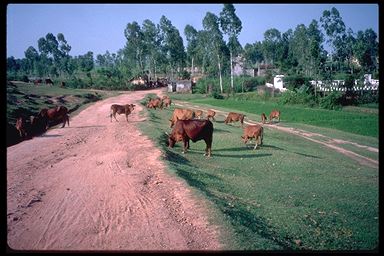
were under severe grazing pressure as indicated by these photos.
Available land for the grazing for the commune's more than 700
cattle was a scarce commodity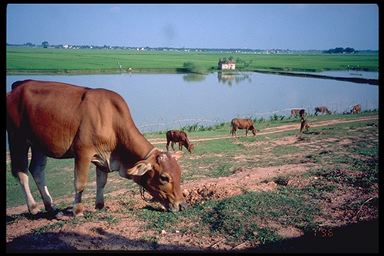 . Unfortunately,
these dike lands were not being utilized at their full potential.
There was little doubt that dramatic increases in productivity
could be achieved within this community by the addition of better
grass management practices. While in Viet Nam, Pease roughed out
a design for a forage demonstration project for the dike lands
within the Trang Viet commune. Unfortunately, Pease was not able
to obtain funding for this project on his return to Canada but
decided to proceed with a much reduced program using his own resources
and the willing services of the National Institute for Animal
Husbandry, the Animal Husbandry Association of Viet Nam and the
Vietnam Agriculture Science Institute. The following outlines
the orginal objectives of the project and concludes with the first
results of this study. The readers will note the effect of the
reduction in available funds to the orignal project's objectives.
. Unfortunately,
these dike lands were not being utilized at their full potential.
There was little doubt that dramatic increases in productivity
could be achieved within this community by the addition of better
grass management practices. While in Viet Nam, Pease roughed out
a design for a forage demonstration project for the dike lands
within the Trang Viet commune. Unfortunately, Pease was not able
to obtain funding for this project on his return to Canada but
decided to proceed with a much reduced program using his own resources
and the willing services of the National Institute for Animal
Husbandry, the Animal Husbandry Association of Viet Nam and the
Vietnam Agriculture Science Institute. The following outlines
the orginal objectives of the project and concludes with the first
results of this study. The readers will note the effect of the
reduction in available funds to the orignal project's objectives.
Original Objectives
Forage Data Analysis and Methodology
Demonstrate the potential of forage production.
Establish and demonstrate specific forage variety production
yields.
Demonstrate best management practices for maximizing forage
production.
Establish and demonstrate which forage variety combinations
can maximize ruminant live weight gains throughout the seasons.
Design
A number of forage plots will be planted on each side of the dike.
The species or species combination of each plot should be repeated
on the opposing side of the bank for comparison under flooding
conditions. One plot in each area should be retained in its natural
state as a control and not have fertilizer or weed control applied.
Click here for a scematic of
the original demonstation plot design
Soil sampling should be done at the onset of the program with
tests repeated on an annual basis.
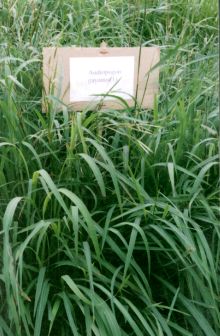
Signs should be erected on each plot to indicate the species planted
and the date sown. In addition, a written record should be made
containing all data for each plot as well as the quantity and
analysis of the fertilizer applied at planting or in subsequent
applications. This written report will be the responsibility of
the NIAH forage specialist.
To obtain a value for forage production, a suitable program for
measuring and analysing the feed value for each plot should be
designed by the forage specialist. It will be important to not
only determine the protein content of the forages but also their
mineral content in order that a test group of cattle can be fed
a balanced mineral ration.
The plot areas will also include a number of legume and or legume
tree species. These should be planted in rows, perhaps dividing
the plots, on a line running down the bank so as to assess their
suitability under the differing environmental conditions. Again,
a method of obtaining relative production values of each species
will have to be devised by NIAH staff.
Implementation
Forage Plot Establishment
NIAH crop specialists will supervise the planting of the forage
plots and the construction of the barrier fencing. While there
is local resistance to the use of high tensile electric fencing
and no funds have been budgeted for its construction, there are
great advantages to this system. If sufficient funds could be
made available ($1,000US) or perhaps materials donated by a manufacturer,
this site may serve to show the many advantages to using high
power electric fencing for animal control - especially if it were
to be applied to strip grazing programs at some future date.
NIAH specialists will carry out the soil analysis and select the
appropriate fertilizer for optimum plant establishment and growth.
All forage plots should be seeded at the same time. Forage species
selection for the test plots should be made after consultation
between NIAH crop and livestock specialists.
A weigh scale will be purchased to measure the forage production
from the plots.
A photographic record should be kept from this initial stage and
throughout the duration of the project.
Forage Production
The forage plots will demonstrate the production potential of
the dike lands. The measurement of this production can be accomplished
using two methods:
(1) Cut and Carry: Forage can be made a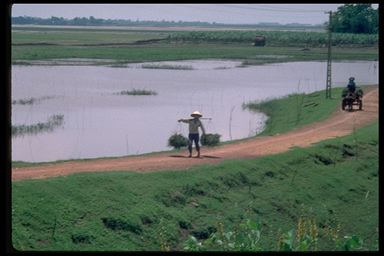 vailable at no charge to the members
of the commune using a "cut and carry" method. Having
this forage freely available will ensure accurate weights! This
forage would be harvested by individuals under the direction of
the Project Manager. The Project Manager would record the plot
number, species harvested, date of harvest and weight harvested
in every instance. This information can then be used to assess
the plot production for each species. NIAH crop specialists will
direct the Project Manager as to the timing of harvest for each
plot so as to best utilize the crop's potential. Small forage
samples will be taken during each plot's harvest period for nutritional
analysis by NIAH crop specialists.
vailable at no charge to the members
of the commune using a "cut and carry" method. Having
this forage freely available will ensure accurate weights! This
forage would be harvested by individuals under the direction of
the Project Manager. The Project Manager would record the plot
number, species harvested, date of harvest and weight harvested
in every instance. This information can then be used to assess
the plot production for each species. NIAH crop specialists will
direct the Project Manager as to the timing of harvest for each
plot so as to best utilize the crop's potential. Small forage
samples will be taken during each plot's harvest period for nutritional
analysis by NIAH crop specialists.
(2) Livestock Consumption: The addition of a livestock
component to this project will add significantly to its value.
Unlike North America where forage crops are commonly sold in the
form of hay, it may be very difficult to arrive at a market value
for the forage produced on these Vietnamese plots. Having cattle
consume this forage and turn it into kilograms of beef will allow
a monetary figure to be placed on the total site production (VDN/ha).
This will not detract from the individual plot production studies
that can still be assessed using the cut and weigh method combined
with the forage analysis as employed in the above example. Livestock
will not be allowed access to the plots. The livestock will also
be used to show how these various forages can be utilized in combination
for optimum beef production. NIAH livestock specialists, in conjunction
with NIAH crop specialists, will decide which plant species should
be grown on these plots in order to provide adequate nutrition
to the growing livestock throughout the various seasons. It may
be necessary to store some forage during times of high production
in order that adequate feed resources are available for the livestock
during low production periods. Again, a very important demonstration
for future co-operative feeding efforts.
While the forage plots can be a stand alone project, it is
hoped that the livestock component can be added. The addition
of the livestock will demonstrate how best to use this forage
production for optimum beef production. Forage production is always
looked on as a secondary crop, having minor economic importance.
This project may be able to show that forages can produce monetary
returns equal to that of many other crops grown in Vietnam.
Forage Project - 1st Report
THE EXPERIMENTAL RESULTS FOR THE PLANTING OF PRODUCTION GRASSES
ON THE DIKE AS A MEANS OF INCREASING AVAILABLE LIVESTOCK FEED
AND AS A MEANS OF CONTRIBUTING TO THE DIKE PROTECTION.
(July 6, 1999)
Nguyen van Thien, Vu Ngoc Ty (Animal Husbandry Association
of Viet Nam)
Tran Thanh Thuy (Viet Nam Agriculture Science Institute)
Le Hoa Binh, Phan thi Phan (National Institute of Animal Husbandry)
I. Introduction
 The road to Trang Viet with Red River flood
waters receeding to the left of the photo.
The road to Trang Viet with Red River flood
waters receeding to the left of the photo.
|
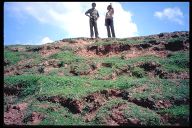 An example of erosion to the dyke due to overgrazing
1996.
An example of erosion to the dyke due to overgrazing
1996.
|
The 1995 census registered 7,700 kilometers of earth formed dike
in the country of Vietnam. Each year these dike lands are replanted
with grasses to control erosion. Unfortunately, many of these
grass species used are natural grasses and therefore not too productive.
If these natural grasses are replaced by more productive grasses;
on the one hand we can produce abundance of forage, on the other
hand we are also able to continue to provide protection to the
dike.
During 1998 and 1999, under the assistance of David Pease, a Canadian
farmer, we have commenced the following experiment: To plant the
productive grasses on the dike to increase the livestock feedstuff
and to contribute to dike protection.
II. Materials and Methods
(A) Location - On the Red River dike of Trang Viet commune,
Me Linh district, Vinh Phuc province (at km 44+500)
(B) Experiment time period - From March 1, 1998 to March
31, 1999
(C) Experimental Methods
Stage One
(i)Species
To plant on small squares from March 1, 1998 to August 31,
1998 the following grass varieties:
Andropogon gayanus (#1)
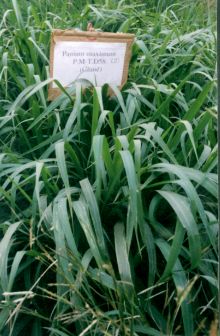
Panacum maximum TD-58 [PM-TD58] (#2)
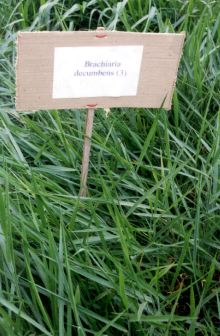
Brachaiaria decumbens (#3)
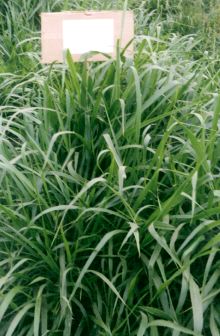
Brachiaria brizantha (#4)
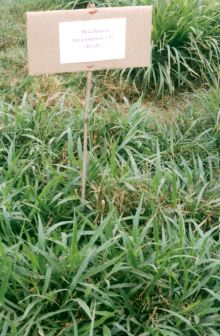
Brachiaria ruzizinensis (#5)
Digitaria decumbens commun (#6)
(ii) Plot design
The total project area was 54 squared meters in size divided into
18 squares each measuring 3 meters squared. To accurately assess
the potential of each species, three of these small squares were
alocated for each species using the following planting scheme:
|
#5 |
#3 |
#1 |
|
#6 |
#4 |
#2 |
|
#1 |
#5 |
#3 |
|
#2 |
#6 |
#4 |
|
#3 |
#1 |
#5 |
|
#4 |
#2 |
#6 |
(iii) Planting technique:
-Date of planting was March 3, 1998
-The following were planted as seeds: Androppgon; PM-TD 58; B.
decumbens; B. Briantha; B. ruzizinensis.
-The following utilized stem planting: D. decumbens commun.
-The grasses were planted on furrows of width 50cm.
-Fertilizer before planting: 40kg P205/ha (200 kg super P/ha)
and 40 kg K2SO4 (100 kg Sulfate K/ha) after harvest 25 Urea kg/ha.
Stage Two
(i)Species
Large lots were planted from September 1, 1998 to March 31,
1999 with the following species:
-Brachiaria decumbens (#7)
-Digitaria decumbens commun (#8)
- Brachiaria decumbens + Digitaria decumbens commun (#9)
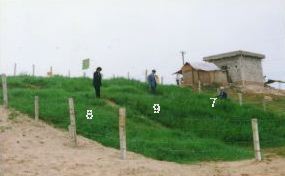
(ii) Plot design
The 2 grass varieties were planted on an area totalling 450 meters
squared divided into three 150 square metered plots as follows:
(iii)Planting technique:
-Date of planting was September 22, 1998
-B. decumbens was planted by seed and D. decumbens commun was
stem planted.
-The greasses were planted in furrows of width 40cm.
-Fertilizer before planting was micro-bacteria fertilizer at a
rate of 400kg/ha.
III Results and Discussions
Stage one
The sprout, growth and harvesting capacities of the 6 grass varieties
are presented in the following table:
 #1 Andropogon Gayanus
|
 #2 PM-TD 58
|
 #3 B. Decumbens
|
 #4 B. Brizantha
|
 #5 B. Ruzizinensis
|
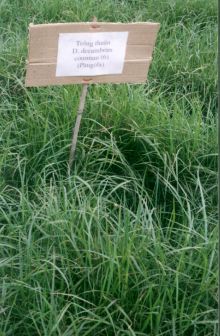 #6 D. decumbens commun
|
|
Plot # |
Grass
Variety
|
Days to sprout emergence |
Grass height
at 1 month (cm)
|
Weight of grass harvested per square (kg) |
Projected annual yield of grass per ha. |
|
1 |
Andropogon |
20 |
37 |
2.00 |
79.7 |
|
2 |
PM-TD 58 |
13 |
30 |
4.05 |
162.2 |
|
3 |
B. decumbens |
13 |
10 |
3.63 |
145.4 |
|
4 |
B. brizantha |
8 |
10 |
3.78 |
151.5 |
|
5 |
B. ruzizinensis |
8 |
15 |
3.38 |
135.3 |
|
6 |
D. decumbens
commun
|
10 |
45 |
3.2 |
72.0 |
| |
|
|
|
|
|
Among the 5 grass varieties that were planted by seed, the
sprouting time of B. brizantha and B. ruzizinensis were the shortest
(8 days), then PM-TD 58 and B. decumbens (13 days). The latest
one was Andropogon at 20 days. The sprouting time for the stem
planting grass variety D. decumbens commun was 10 days.
Among the seed planted varieties, the vertical growth rate
of PM-TD 58 was the greatest at 30 cm at one month followed by
Adropogon (27cm), B. ruzizinensis (15cm) with the slowest being
B. decumbens and B. brizantha at 10cm. The growth rate of the
stem planted D. decumbens commun was by far the greatest of the
entire plot at 45 cm.
It is important to note that the vertical growth rate of these
varieties did not necesarily predict the productivity of these
species for while the D.decumbens commun was the tallest at one
month it yielded the lowest of the six species tested at only
72.0 tonnes of grass per hectare. The harvesting capacity of the
PM-TD 58 was the highest at 162.2T/Ha followed by the B. brizntha,
then the B. Decumbens and the B. ruzizinensis.
In summary, all of the 6 species of grasses are suitable for
planting and growth on the Red River dike. Their productivity
is quite high with four species producing over 135T/ha during
the year.{ It would have been interesting to compare these production
rates with that of the traditional species of grasses that are
now grown on the remainder of the dike lands.}
Stage Two
The two grass varieties had each sprouted 30 days after planting
and, after 60 days, all three plots were fully covered by these
grasses.
It appears that these grass species have had no adverse affect
on the structure of the dike.
This experiment will be continued beyond April, 1999 by harvesting
these grasses from the three plots to provide feed for one cattle
animal. During this feeding period the dike will be constantly
monitored to assess the influence of these grass plots on the
dike.
Conclusion
1. We can plant the above grass varieties on the dike as a means
of increasing the production of livestock feed.
2. The planting of these grass species on the dike has no adverse
affect on the dike. Moreover, these species actually guard against
possible erosion to the dike.
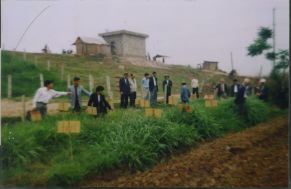
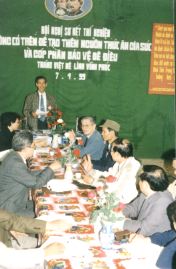 The committee meeting to discuss the results of the
forage trials.
The committee meeting to discuss the results of the
forage trials.